Proposed changes to acute stroke services
1 Executive summary
1.1 Background
The hyperacute and acute stroke services, delivered by Nottingham University Hospitals (NUH), were temporarily moved to the Queens Medical Centre (QMC) site in July 2020, enabling NUH to comply with the national directives relating to nosocomial (hospital acquired) Covid-19 infections, and the implementation of pathways to ensure that patients with Covid-19 were managed separately to those without Covid-19, in order to reduce transmission.
Prior to this, the national Getting it Right First Time (GIRFT) assessment (2019) and the regional Stroke Integrated Care System review had already recommended the relocation of hyperacute and acute stroke services to the QMC campus, due to the many benefits to the time critical Stroke Patient Pathway.
To deliver further benefits for people experiencing a stroke, the potential opportunities provided by making this a permanent service change have been reviewed.
The purpose of this report is to provide an update on the citizen intelligence and insight gathered from patients, carers, clinicians and associated health and care services impacted by the reconfiguration of acute stroke services at NUH.
1.2 Methods
A range of evidence has been considered within this report to understand:
- Clinical effectiveness and quality impact.
- Impact on clinical services and community providers.
- Impact on travel.
- Whether patients are supportive of the proposals, through patient and public engagement undertaken through Tomorrow’s NUH (TNUH), patient case studies and targeted engagement with patients and their carers who have direct experience of stroke services.
1.3 Key findings
- There is strong national evidence for the co-location of stroke services to improve the outcomes for people experiencing a stroke.
- The relocation of hyperacute and acute stroke services has enabled assessments and interventions to occur in a more timely way, during the earliest and most time critical stages of the Stroke Patient Pathway.
- The hyperacute and acute stroke services are now geographically aligned with the clinical services which optimise the stroke pathway. The relocation of the services has eliminated significant delays in patients receiving the required treatment for an optimal outcome following a stroke.
- Relocation of stroke services to QMC from the City Hospital did not result in a change in activity at Sherwood Forest Hospitals.
- Feedback from community providers support the relocation, highlighting this has been a positive move in line with national targets, leading to a possible reduction in the number of deaths due to stroke and potentially increasing the complexity of patients.
- A Travel Impact Assessment showed there was minimal impact on the distance travelled to QMC, as opposed to City Hospital.
- Following Phase 1 of the pre-consultation engagement for TNUH, 80% of survey respondents supported the plans for emergency care being on one site, which would include the hyperacute and acute stroke services.
- As part of Phase 2 of the TNUH pre-consultation engagement, we heard that the majority felt that it would be beneficial to have similar services in one location, as this would make access to the correct treatment in the right setting much easier for patients, reduce waiting times for appointments and ensuring continuity of care. There were positive comments around an increase in confidence that the care needed would be available sooner, with specialised services in one place.
- Patients and carers with direct experience of the services following the relocation describe the quality of care as good or excellent.
2 Background
Over the course of the Covid-19 pandemic, the Nottinghamshire County Council Health Scrutiny Committee and Nottingham City Council Health and Adult Social Care Scrutiny Committee were briefed on changes to services that have been made to ensure that patients and staff remain safe. In the main, these were changes made by providers to manage workforce and operational pressures and to maintain patient safety.
The Committees were informed in June 2020 of a change that was to be implemented in July 2020 to reconfigure local acute stroke services, to manage the risk of Covid-19 infections among patients and staff. Through this change, additional capacity was created on the City Campus site, which allowed NUH to treat patients with Covid-19 separately to those who were not infected.
As described at the time the change was implemented, there is a clear clinical case for the reconfiguration of stroke services and specifically for the centralisation of hyperacute stroke services. The change is aligned to regional and national stroke strategies and is a stated ambition of the local Clinical and Community Services Strategy review of stroke services. This review was underpinned by strong patient and public involvement, with stroke survivors forming part of the work alongside staff and clinicians and the Stroke Association supporting a number of patient engagement sessions.
The temporary change to stroke services at NUH supported the response to the Covid-19 pandemic, and has also aligned service provision with regional and national recommendations. In order to deliver further benefits for people experiencing a stroke, the potential opportunities provided by making this a permanent service change have been reviewed.
3 Methods
A range of evidence has been considered within this report to understand:
- Clinical effectiveness and quality impact.
- Impact on clinical services and community providers.
- Impact on travel.
- Whether patients are supportive of the proposals, through patient and public engagement
undertaken through Tomorrow’s NUH (TNUH), patient case studies and targeted engagement
with patients and their carers who have direct experience of stroke services.
4 Findings
4.1 Clinical effectiveness and quality impact
Although the July 2020 relocation was a response to the Covid-19 pandemic, the relocation of hyperacute and acute stroke services has enabled assessments and interventions to occur in a more timely way during the earliest and most time critical stages of the Stroke Patient Pathway. There are three significant geographical alignments which optimise the stroke pathway:
- The Hyperacute & Acute Stroke Services are geographically aligned with a CT scanner.
- The Hyperacute & Acute Stroke Services are now geographically aligned with the
Mechanical Thrombectomy Service. - The Hyperacute & Acute Stroke Services are now geographically aligned with other critical
specialities such as the Emergency Department (ED), Neurology, Neurosurgery and
Vascular Surgery.
The positive impact on patients of the geographical alignment of hyperacute and acute stroke services with the above services on the Queens Medical Centre (QMC) site should not be underestimated. Rapid access to treatment can mean the difference between a full recovery and permanent disability. Between September 2019 and July 2022 between 141 and 228 patients per month were admitted to QMC, presenting with a stroke (Figure 1).
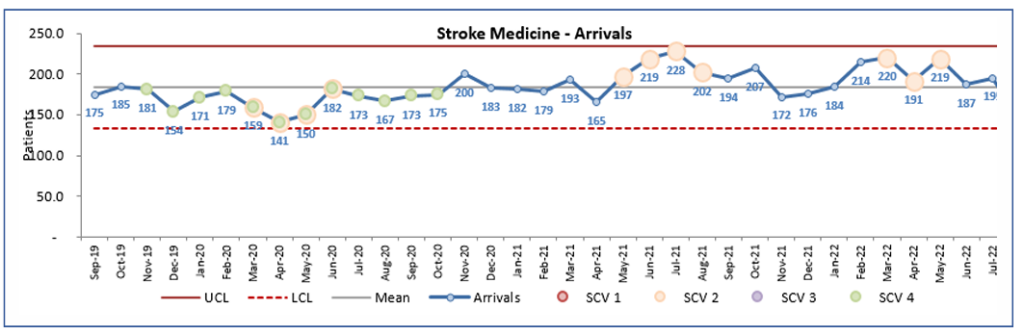
Figure 1 Stroke medicine arrivals at QMC (Sept 2019 – July 2022)
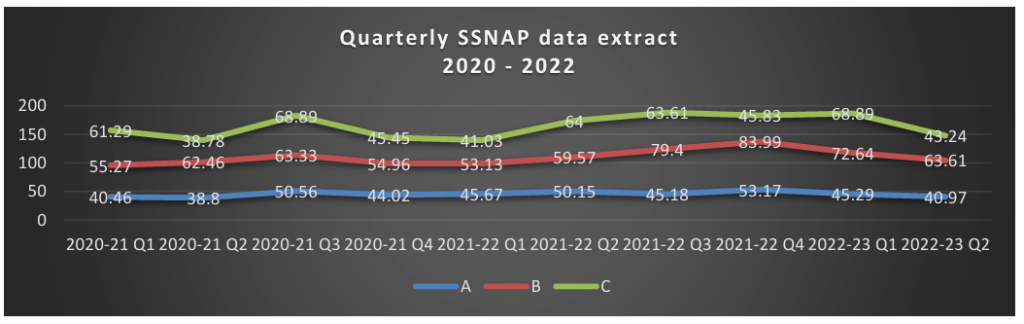
The data taken from the national Sentinel Stroke National Audit Programme (SSNAP) Returns for Nottingham gives further insight into patients flows (Figure 2). There are some points to note about the data in the chart on the following page:
- The data collection system at NUH has historically been non-electronic. The national data set that has to be submitted contains answers to over 400 questions, making it ill suited to a manual process. During 2021, a quality improvement programme which aims at replacing manual processes with electronic processes, to improve accuracy of reporting was launched.
- The impact of the Covid-19, and the subsequent peaks and troughs in the number of Covid-19 levels patients in the hospital.
- Understanding of the impact of two pathways into the stroke service on front door timings.
With respect of the impact of the two pathways into the stroke service – the two entry points are:
a) Patients arrive via the ambulance having been identified as having had a stroke and are seen immediately by specialist stroke staff in ED, and placed on the stroke pathway.
b) For patients who self-present at the ED QMC and where it is not immediately apparent that they have had a stroke, they are assessed by ED staff and are then referred to the stroke team, if a stroke has been identified.
For those who self-present (pathway b above) the location of the hyperacute and stroke acute services on the QMC site means that they are able to be transferred from the ED to the hyperacute stroke unit quicker, than if the hyperacute unit was still on the City Hospital campus.
Those who self-present to ED and enter the stroke pathway via pathway b will almost always have to wait longer for some of the first stroke specific interventions (e.g. they are less likely to be scanned within one hour of arrival). For example, the symptoms for a range of neurological conditions can be the same as those of a stroke and it takes time to make this differential diagnosis and get the patient onto the correct pathway- be it stroke or some other condition related pathway. Often 40% or more of stroke patients come via pathway b. During 2022 we have seen greater numbers of patients self-presenting to ED (pathway b) rather than coming via ambulance (Pathway a). We are currently exploring the reasons for this.
*Thrombolysis involves administering is a ‘clot
busting’ medication used to treat ischaemic strokes.
It is recommended that administration
occurs within 4.5 hours of the onset of a stroke
A % of patients scanned within 1 hour of clock start
B % of patients directly admitted to a stroke unit within 4 hours of clock start
C % of patients who were thrombolysed * within 1 hour of clock start
Figure 2. Sentinel Stroke National Audit Programme (SSNAP) for Nottingham
In quarters 1-4 2021-22, there was an upward trajectory in the number of patients being scanned within one hour of clock start and the percentage of patients directly admitted to the hyperacute stroke unit. However, the figures for the first two quarters of 2022-23 are slightly lower. This may be connected to the external factor mentioned earlier – the fact that more people have started self presenting rather than coming to ED via an ambulance, also our data collection processes are developing and resulting in more accurate data. The service is currently reviewing all its front door processes (interface with ED) to make sure there are no contributing pathway issues and looking at reasons why we have seen an increase in patients self-presenting to ED, rather than attending by ambulance.
4.2 Impact on clinical services
4.2.1 Impact on other NUH services
The hyperacute and acute stroke services are now geographically aligned with the clinical services which optimise the stroke pathway – CT scanner, ED, Neurology and Neurology Services and Medical Thrombectomy. The relocation of the services has eliminated significant delays in patients receiving the required treatment for an optimal outcome following a stroke.
A business case has been approved to expand the current Mechanical Thrombectomy service to 24/7, which will ensure equity of access to a MT for all eligible patients. This expansion is only possible due to the move of the hyperacute and acute stroke service.
4.2.2 Activity impact on Sherwood Forest Hospitals Trust (SFHT)
As part of the Tomorrow’s NUH programme, clinicians at SFHT and NUH considered whether the stroke services move increased the number of patients travelling north to SFHT, rather than travelling the additional miles from City Hospital to QMC. The analysis focused on those patients in the post code areas NG14 to NG25 as the areas likely to be impacted by the change.
Analysis between January 2019 and September 2021 showed that SFHT had a growth of 0.6 patients per month, with no measurable difference before or after moving the NUH stroke services to QMC, consequently the 0.6 patients are most likely attributed to geographic and demographic factors. NUH showed no significant growth to stroke medicine during this time period, therefore moving the services to QMC did not result in a change in activity.
4.2.3 Impact on community providers
Feedback has been received from both the Nottingham CityCare Community Stroke Team who provide rehabilitation for Nottingham City patients, and from the South Nottinghamshire Community Stroke Team who provide rehabilitation for Nottinghamshire County patients.
Both teams have reported that, since the move, there has been a change in the type of patients
referred from the acute stroke service and there has been an increase in:
- Younger patients
- Complexity of presentation
- Dependency of patients
- Number of craniotomy patients
The reasons for this are unclear however, anecdotally, it has been suggested that this is due to more collaboration between the neurologists and stroke consultants with the wards being closer together at QMC. This has allowed more interventional approaches to be used, such as an increase in Mechanical Thrombectomy and neuro surgical interventions (decompression surgery).
There has been a different ask of community services and they have had to upskill around some of the neuro-type presentations which has put a strain on resources, but it is not yet clear how much of this is Covid related and the impact of pressures on other services.
The Community Stroke Teams have seen a fluctuation in referrals month on month with their caseload numbers increasing, suggesting they may be picking patients up sooner in the pathway, or the total number of referrals have increased, or that, due to complexity, patients need to remain in their service longer for rehabilitation i.e. more intensity of input for longer.
Overall, the feedback is that this has been a positive move in line with national targets, possibly reducing the number of deaths due to stroke and potentially increasing the complexity of patients.
4.3 Impact on travel time
As part of the Integrated Impact Assessment undertaken for Tomorrow’s NUH in May 2021, an analysis of travel times was undertaken to understand the impact if all stroke services were moved to QMC. A system called TravelTime API was used to calculate the average journey and distance between each population weighted LSOA (Lower Super Output Area) centres in the Nottingham and Nottinghamshire Clinical Commissioning Group, to the QMC and City Hospital sites. The system calculated distance and travel times based on actual travel routes making it more accurate. The travel times noted below are average times taken from the centre of the most densely populated part of the LSOA:
- Moving the stroke services to QMC slightly increases travel time, by one minute, for the most deprived populations, who are most densely populated around the City site.
- Moving the stroke services will significantly decrease travel time for the least and middle deprived populations.
- Off-peak driving times will improve across the board for a QMC service, though the smallest improvement is in the most deprived populations (<1 minute).
- Stroke services being moved to QMC will have a positive impact on public transport time for all, though the smallest improvement is for the most deprived populations (2 minutes).
4.4 Patient and public engagement
4.4.1 Tomorrows NUH
Phase 1 pre-consultation engagement
In November 2020, Nottingham and Nottinghamshire Clinical Commissioning Group (hereafter referred to as NHS Nottingham and Nottinghamshire Integrated Care Board (ICB)) launched a public engagement on proposals to reconfigure hospital services in Nottingham, specifically the “Tomorrow’s NUH” programme relating to services provided by NUH.
The engagement was focused on a draft outline clinical model. One of the principles within the model was that all emergency services would be co-located on a single site rather than the existing configuration whereby the majority of emergency services are based at the Queen’s Medical Centre (QMC) site, with a small number of emergency specialities based at City Hospital i.e. stroke, cardiology and respiratory.
Following Phase 1 of the pre-consultation engagement, 80% of survey respondents strongly or slightly supported the plans for emergency care being on one site, which would include the hyperacute and acute stroke services.
The specific benefits recognised were around a reduced need to transfer patients between sites, a concentration of speciality care resources and expertise on one site, and more prompt access to better and safer speciality care, as well as patients having to spend less time in hospital.
In January 2021, as part of the first phase of pre-consultation engagement, Healthwatch Nottingham and Nottinghamshire were commissioned to undertaken targeted engagement with specific diverse and ethnic communities:
- Black, Asian, Minority Ethnic and Refugee (BAMER)
- People with long term conditions/poor health outcomes
- People with a disability
- Frail older people
- Maternity service users
- Young people
- Lesbian, Gay, Bisexual and Transgender (LGBT)
They gained the views of 150 people.
Overall, people were very positive about the idea of modernising the hospitals; receiving emergency treatment at one hospital; care closer to home, meaning less travel to busy hospital sites; separating emergency and elective care, if this meant fewer operations would be cancelled; and the use of online and telephone consultations where appropriate. There was support for receiving treatment in one place rather than having to be transferred between sites.
Phase 2 pre-consultation engagement
Further engagement was launched by NHS Nottingham and Nottinghamshire ICB in March 2022, with approximately 2,000 individuals participating in this phase, through completing an online survey, attending an event or providing a response via social media.
Many individuals (72%) were supportive of having all emergency care services on one site. This would mean more streamlined patient pathways and a single point of access, resulting in a more positive patient experience. There was a perception that this proposal would alleviate pressures in the system and ensure patient care is delivered in the most clinically appropriate setting, and that there would be a reduction in travel between QMC and City Hospital for both staff and patients:
“Ensuring patients receive the right care, first time in the right place and are safe and effective.”
“Smoother patient pathways into A&E.”
“It makes sense to have the ED where there is access to specialist equipment so that people can
access these if needed.”
Concerns were raised around workforce and the potential pressure that the proposals could place on them, particularly if the service is accessed by patients who could receive care in other locations. Comments were received around inappropriate attendances at A&E in the current climate, with access to the walk-in facilities at other sites allowing faster access to treatment.
“I would prefer that some services are still accessed through City Hospital as QMC is already very
busy, crowded and difficult to access.”
It was acknowledged that having all A&E facilities on one site could reduce the travel impact on some patients:
“Having most emergency care based at QMC would be good as it has the best transport links
(multiple bus routes and the tram go past it) so it would be easiest to reach.”
“QMC is nearer to my home and easier to access. However, would still entail two buses or bus and
tram. I can see the rational of having these services on one site, to save transporting patients from
A&E to City Hospital. Further, specialist staff may be available at the main site for urgent
assessments”
However, for some patients, there would be increased travel times and potentially additional pressure on parking facilities at QMC. Concerns were also raised around having the provision across two sites for specific services if emergency care was needed and the patients had to be transferred.
In summary, the majority felt that it would be beneficial to have similar services in one location, as this would make access to the correct treatment in the right setting much easier for patients, reduce waiting times for appointments and ensuring continuity of care. There were positive comments around an increase in confidence that the care needed would be available sooner, with specialised services in one place.
4.4.2 Patient case studies
The following three case studies are of three patients who have been through the Stroke Patient Pathway following the relocation in July 2020, which highlight the benefits of the relocation to patients. The case study of Mr K highlights the benefits of relocation with respect of providing access to patients with cutting edge treatments. Mr B demonstrates the benefits of the relocation during the first stages of the patient pathway. Mrs J demonstrates the benefits of having the acute stroke services co-located with the neuro-surgery services.
NUH Stroke Service on the cutting edge of new developments in stroke medicine
benefitting patients
Case Study: Mr K
During August 2022, Mr K presented to the Emergency Department at QMC with a severe stroke. He was immediately taken to the resuscitation area in the Emergency Department where thepatient was assessed by a Specialist Nurse Practitioner. Mr K was assessed, scanned and thrombolysed very rapidly – less than two hours from the onset of his stroke.
A rapid referral was made for consideration for a Mechanical Thrombectomy. This was an evolving and borderline case so the imaging was rapidly repeated and it was agreed that the patient was not suitable for a Mechanical Thrombectomy. However, there was a risk of brain swelling so the patient was offered the opportunity to be enrolled in a new clinical trial testing a drug to prevent brain oedema, which reduces the need for surgery and reduces the risk of death.
This patient is the first patient in Nottingham to be enrolled in the study and only one of a handful in the United Kingdom. Mr K would not have had access to this clinical trial but for the excellent team of medical, nursing and research staff working together, but also because stroke services are now located on the QMC site and aligned with other relevant key services.
Case study: Mr B
Mr B was eating breakfast when his wife left the room briefly. By the time she returned he was unable to move one side and was unable to speak. The Ambulance Service attended and contacted QMC to provide details that they were bringing in Mr B and that he likely had had a stroke. Mr B’s arrival at QMC was registered at 09:37am and he was assessed by specialist stroke staff in the ED. Mr B Had a CT scan of his brain which did not show any evidence of haemorrhage, however it did show what kind of stroke he had had, and it was determined the most appropriate treatment in his case was thrombolysis.
Thrombolysis involves the administration of a clot-busting drug and its administration is time critical, it needs to be administered within 4.5 hours following the onset of stroke symptoms. The thrombolysis treatment was administered and monitored by specialist stroke staff. Following his thrombolysis treatment, Mr B was transferred to the Hyperacute Stroke Unit at around 11:41am, just over 2 hours from the time he arrived at the QMC ED.
Mr B recovered well and was discharged home six days after his stroke.
Case study: Mrs J
Following a stroke Mrs J was admitted to a Hyperacute Stroke bed at QMC. The next day her condition deteriorated and a CT scan was ordered. Following this it was determined that Mrs J’s stroke had extended and she required an immediate decompressive hemicraniectomy, without which she was unlikely to survive the night.
A decompressive hemicraniectomy is when a portion of the skull is surgically removed that gives space for the swollen brain to bulge and reduces the intracranial pressure. Intracranialhypertension is a build-up of pressure around the brain.
At 4pm Mrs J was assessed by the neurosurgeons and was taken to theatre at 5pm. Following the successful surgical procedure Mrs J spent time on the Critical Care Unit before being transferred to C4 (hyperacute) and then to C5 (acute) at QMC. She was later transferred to the Daybrook ward on the City Hospital campus for rehabilitation therapy before discharge.
4.4.3 Patient and carer feedback
In August 2022, NUH sought the views of patients and carers about their experience of the stroke service, reaching this cohort through outpatient services.
86 patients and carers responded of which:
- 60% described themselves as male, and 40% described themselves as female.
- 59% were over 65 years old.
- 88% described their ethnicity as White British, with the remainder describing their ethnicity
as Asian or Black. - Lived across Ashfield (12%), Broxtowe (24%), Gedling (22%), Newark and Sherwood (2%),
Nottingham City (27%) and Rushcliffe (12%).
Just over half (59%, n = 48) had accessed stroke services at NUH for immediate and urgent
treatment post the July 2020 move. Of this group:
- All described the quality of care received as excellent or good. This was not different to the feedback received from individuals who accessed the service prior to the July 2020 move.
- 88% described the frequency of communication that they or their family member had with NUH staff as excellent or good. For individuals who accessed the service prior to the July 2020 move, all described the frequency of communication as excellent or good.
- 90% described the quality of information that was shared by NUH staff as excellent or good. This was not different to the feedback received from individuals who accessed the service prior to the July 2020 move.
- 67% described the accessibility at QMC as excellent or good, with 8% describing it as poor or very poor. The main reason for this was around lack of parking. This was slightly better than those who has accessed the service prior to the July move, where 64% described accessibility as excellent or good.